
Ever wondered how pumps can transfer corrosive chemicals without a single leak? Or how underwater equipment operates reliably without mechanical seals?
The answer? Magnetic coupling types.
Here’s the deal:
Magnetic couplings are changing the game in industries from chemical processing to renewable energy. And if you’re not using the right type for your application, you’re leaving money (and efficiency) on the table.
In this guide, as a professional magnetic coupling manufacturer, I’ll break down everything you need to know about magnetic coupling types. Including which type works best for YOUR specific needs.
Sound good? Let’s dive in.
Key Takeaways:
- Operating-principle choices: synchronous for precise, zero-slip transfer; eddy current for controlled slip, variable speed and soft starts; hysteresis for ultra-smooth torque and torque limiting — each has distinct efficiency, cost and torque-density trade-offs.
- Structural choices affect packaging and performance: face-to-face (disc) is simple and cost-effective for moderate torque; coaxial (cylindrical) delivers higher torque density and better high-speed performance by increasing length rather than diameter; tubular and special designs serve linear, angular or multi-direction demands.
- Selection framework: define operating/starting/peak torque (with safety factor), evaluate space constraints (max diameter, axial length), assess environment and temperature limits (NdFeB up to ~150°C, SmCo up to ~300°C, special designs higher), determine speed needs, and calculate total cost of ownership over 5–10 years.
- Key risks and mistakes: undersizing (use ≥1.5× safety factor to avoid complete decoupling), neglecting temperature derating of magnets, ignoring eddy-current heating in metallic barriers, and wrong material/coating choices in corrosive environments.
Table of Contents
What Exactly Are Magnetic Couplings?
Before we jump into the different types, let’s get clear on what we’re talking about.
Magnetic couplings transfer torque WITHOUT physical contact.
(Yep, you read that right.)
Instead of mechanical connections, they use magnetic forces to transmit power from one shaft to another. Think of it like this: two magnets dancing together without ever touching.
The result?
- Zero wear and tear from friction
- No leaks (perfect for hazardous materials)
- Lower maintenance costs
- Quieter operation
In fact, according to recent industry data, magnetic couplings can reduce maintenance costs by up to 75% compared to traditional mechanical seals.
Pretty impressive, right?
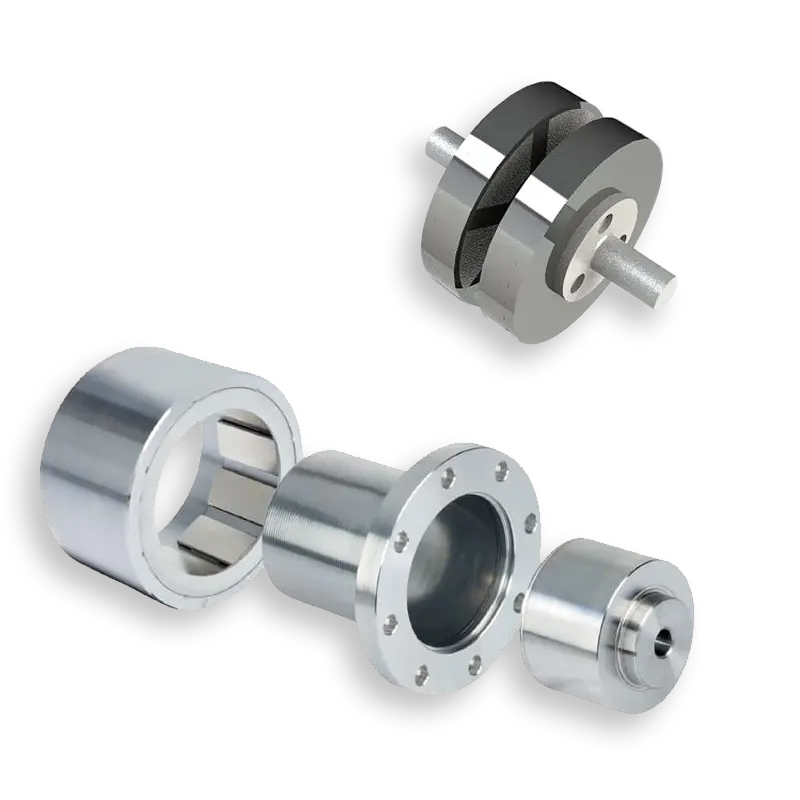
The 3 Main Types of Magnetic Couplings (By Operating Principle)
When it comes to how magnetic couplings actually transfer torque, there are three main players.
Let me break them down for you:
1. Synchronous Magnetic Couplings
This is the heavyweight champion of magnetic couplings.
Synchronous couplings maintain a perfect 1:1 speed ratio between driver and follower. No slip. No lag. Just pure, synchronized power transfer.
How do they work?
They use alternating magnetic poles (think North-South-North-South) on both the driver and follower. When one rotates, the magnetic attraction and repulsion creates a “push-pull” effect that keeps everything in sync.
When to use them:
- When you need precise speed control
- In magnetic drive pumps
- For applications requiring zero slip
Pro Tip: These are your go-to choice for 90% of applications. They’re reliable, efficient, and get the job done.
2. Eddy Current Magnetic Couplings
Here’s where things get interesting.
Eddy current couplings are the “slip clutch” of the magnetic world. They actually NEED a speed difference to work.
The setup? Permanent magnets on one side, conductive material (usually aluminum or copper) on the other.
When there’s relative motion, it induces eddy currents in the conductor. These currents create their own magnetic field, which generates torque.
Best for:
- Variable speed applications
- Soft-start requirements
- Overload protection
The catch? They’re less efficient than synchronous types (usually 94-96% vs 98%+).
But sometimes that controlled slip is exactly what you need.
3. Hysteresis Magnetic Couplings
These are the precision instruments of magnetic couplings.
Hysteresis couplings use special magnetic materials (like Hysterloy) that can be magnetized and demagnetized. They provide incredibly smooth torque transfer and can act as torque limiters.
Perfect for:
- Precision equipment
- Torque limiting applications
- Systems needing ultra-smooth operation
The downside? They’re typically more expensive and have lower torque capacity than the other types.
Magnetic Coupling Types by Structure: The Physical Configurations
Now let’s talk about HOW these couplings are physically built.
Because the structure matters just as much as the operating principle.
Face-to-Face (Disc Type) Couplings
Imagine two pancakes with magnets embedded in them, facing each other.
That’s essentially what we’re dealing with here.
Face-to-face couplings consist of two disc-shaped assemblies with magnets arranged in a circular pattern. The torque capacity increases with diameter – bigger disc, more torque.
The good:
- Simple design
- Cost-effective
- Great for moderate torque applications
The not-so-good:
- Large diameter needed for high torque
- Limited by rotational speed (bigger = slower)
I’ve seen these work brilliantly in magnetic mixers and smaller pumps. But if you need serious torque in a compact package? Keep reading.
Coaxial (Cylindrical) Couplings
This is where magnetic couplings get serious.
Picture one cylinder inside another – that’s your coaxial coupling. The inner rotor nests inside the outer rotor, with magnets on the outside diameter of the inner and inside diameter of the outer.
Here’s what makes them special:
You can increase torque by making them LONGER instead of wider. This means you can pack serious power into a relatively small diameter.
Major advantages:
- Compact design
- Higher torque capacity
- Better for high-speed applications
- Self-centering (near-zero axial force)
The trade-off? They’re typically more expensive than disc types.
But here’s the thing:
When space is tight and torque requirements are high, coaxial couplings are often your ONLY viable option.
Tubular and Special Configurations
Beyond the standard types, you’ve got specialized designs for unique applications:
- Linear magnetic couplings for straight-line motion
- Angular couplings for perpendicular shaft arrangements
- Spherical designs for multi-directional movement
These are niche players, but when you need them, nothing else will do.
Real-World Applications (Where the Rubber Meets the Road)
Let’s get practical.
Where are these different magnetic coupling types actually used?
Chemical Processing
This is THE killer app for magnetic couplings.
Why?
Zero leakage. Period.
When you’re pumping sulfuric acid or other nasty chemicals, a leak isn’t just expensive – it’s dangerous.
Most common type: Coaxial synchronous couplings with containment barriers
Real example: A chemical plant I consulted for switched to magnetic drive pumps and eliminated 100% of their seal-related leaks. ROI in 6 months.
Food & Beverage
Hygiene is everything here.
Magnetic couplings eliminate shaft seals – one less place for bacteria to hide.
Popular choice: Face-to-face couplings for mixers and agitators
Renewable Energy
Wind turbines are embracing magnetic couplings big time.
The reason? Reduced maintenance in hard-to-reach locations.
(Nobody wants to climb a 300-foot tower to replace a mechanical seal.)
Trending type: Large-scale eddy current couplings for variable speed control
Medical Equipment
MRI machines, laboratory mixers, precision pumps – they all use magnetic couplings.
Why? Contamination-free operation and precise control.
Go-to type: Hysteresis couplings for ultra-smooth operation
How to Choose the Right Magnetic Coupling Type (The Framework)
Here’s my proven framework for selecting the right coupling:
Step 1: Define Your Torque Requirements
This is non-negotiable. You MUST know:
- Operating torque
- Starting torque
- Maximum torque (including safety factor)
No guessing. Get the numbers.
Step 2: Evaluate Your Space Constraints
Ask yourself:
- What’s my maximum diameter?
- How much axial length do I have?
- Any special mounting requirements?
This often eliminates options right away.
Step 3: Consider Your Operating Environment
Temperature matters. A lot.
- Standard Neodymium magnets: Good up to 150°C
- Samarium Cobalt: Can handle 300°C+
- Special high-temp designs: Up to 400°C
Don’t forget about corrosion resistance too.
Step 4: Determine Speed Requirements
High-speed applications? Coaxial designs typically win.
Low-speed, high-torque? Face-to-face might be more cost-effective.
Step 5: Calculate Your Budget (Total Cost of Ownership)
Here’s what most people get wrong:
They only look at initial cost.
But magnetic couplings save money through:
- Reduced maintenance
- No seal replacements
- Lower downtime
- Energy efficiency
Do the math over 5-10 years. The “expensive” option often isn’t.
Common Mistakes to Avoid
Let me save you some headaches.
These are the mistakes I see over and over:
Mistake #1: Undersizing for Cost Savings
Magnetic couplings should be sized with AT LEAST a 1.5x safety factor.
Why? Unlike mechanical couplings, when magnetic couplings “slip,” they can decouple completely.
Mistake #2: Ignoring Temperature Derating
Magnets lose strength as temperature increases.
At 100°C, Neodymium magnets might only have 80% of their room-temperature strength.
Always check the temperature curves.
Mistake #3: Forgetting About Eddy Current Heating
In high-speed applications with metallic containment barriers, eddy current heating can be significant.
I’ve seen pumps overheat because nobody calculated the heat generation in the barrier.
Mistake #4: Wrong Material Selection
Using Neodymium in a corrosive environment without proper coating?
Bad idea.
Samarium Cobalt costs more but offers superior corrosion resistance.
The Future of Magnetic Coupling Technology
The magnetic coupling industry isn’t standing still.
Here’s what’s coming:
Advanced Materials: New magnetic materials promise 20-30% stronger fields in the same package.
Smart Couplings: Integrated sensors for torque monitoring and predictive maintenance.
Hybrid Designs: Combining magnetic and mechanical elements for fail-safe operation.
3D Printed Components: Custom magnetic arrays for optimized performance.
The Bottom Line
Magnetic coupling types offer solutions that mechanical couplings simply can’t match.
Whether it’s leak-free operation in chemical processing, maintenance-free performance in wind turbines, or contamination-free mixing in pharmaceutical applications, there’s a magnetic coupling type that fits.
The key?
Understanding your specific requirements and matching them to the right coupling design.
Remember:
- Synchronous couplings for most applications
- Eddy current when you need slip
- Hysteresis for precision control
- Coaxial for high torque in tight spaces
- Face-to-face for cost-effective moderate torque
Choose wisely, size properly, and you’ll have a coupling system that outlasts and outperforms traditional mechanical alternatives.
Now it’s your turn.
What type of magnetic coupling makes sense for YOUR application?
The technology is proven. The benefits are clear. And with the right magnetic coupling types, you can solve problems that mechanical systems simply can’t touch.