Ever wondered how many magnets are needed for a Halbach array?
You’re not alone. This question pops up all the time when people first discover these fascinating magnetic arrangements.
Here’s the deal:
How Many Magnets Are Needed for a Halbach Array?
A Halbach array can technically work with as few as 4 magnets. But most practical applications use 8 or more for optimal performance.
In this post, as a professional Halbach array manufacturer, let me break down the detailed analysis about how many magnets needed for a Halbach array to you.
What Exactly Is a Halbach Array?
Before we dive into numbers, let’s quickly cover what makes a Halbach array special.
A Halbach array is a specific arrangement of permanent magnets that creates something almost magical: it strengthens the magnetic field on one side while nearly canceling it on the other.
Think of it like this:
Regular magnets spread their magnetic field equally in all directions. But a Halbach array focuses that power, creating a one-sided magnetic field that’s up to twice as strong.
(Pretty cool, right?)
The Minimum: Why 4 Magnets Matter
Here’s the thing:
The magic of a Halbach array comes from its repeating pattern of magnetic orientations.
The basic sequence looks like this:
- Up
- Left
- Down
- Right
That’s 4 magnets creating one complete “wavelength” of the pattern.
So technically? You need a minimum of 4 magnets to create a basic Halbach array.
But here’s what most people don’t realize:
While 4 magnets will demonstrate the Halbach effect, it’s barely scratching the surface of what’s possible.
The Sweet Spot: 8-12 Magnets
In my experience reviewing magnetic applications, most practical Halbach arrays use between 8 and 12 magnets.
Why?
Better field uniformity. More magnets = smoother magnetic field transitions.
Stronger overall effect. The field strengthening becomes more pronounced with additional cycles.
Practical size. This range hits the sweet spot between effectiveness and manageability.
For example:
- Small motors often use 8-magnet arrays
- Lab demonstrations typically feature 12 magnets
- Magnetic levitation experiments work well with 10-16 magnets
Going Big: When You Need More
Some applications demand serious magnetic muscle.
I’m talking about:
- Particle accelerators (hundreds of magnets)
- MRI machines (custom-configured arrays)
- Industrial maglev systems (continuous arrays)
These setups can use anywhere from 32 to several hundred individual magnets.
The bottom line?
The number scales with your needs. Bigger applications = more magnets.
Practical Considerations for Your Array
Let’s get practical.
If you’re building your first Halbach array, here’s what I recommend:
Start with 8 magnets. This gives you two complete pattern cycles and clearly demonstrates the effect.
Use cubic neodymium magnets. Size matters less than consistency – 10mm or 1/2″ cubes work great.
Consider assembly challenges. More magnets = more complexity. The forces involved can be surprisingly strong.
Pro Tip: Building with 12 magnets hits the sweet spot for most hobbyist and demonstration purposes. You’ll see clear results without breaking the bank.
The Shape Factor
Here’s something interesting:
The number of magnets also depends on your array configuration.
Linear arrays: No strict requirements beyond the 4-magnet minimum. Common setups use 8, 12, or 16.
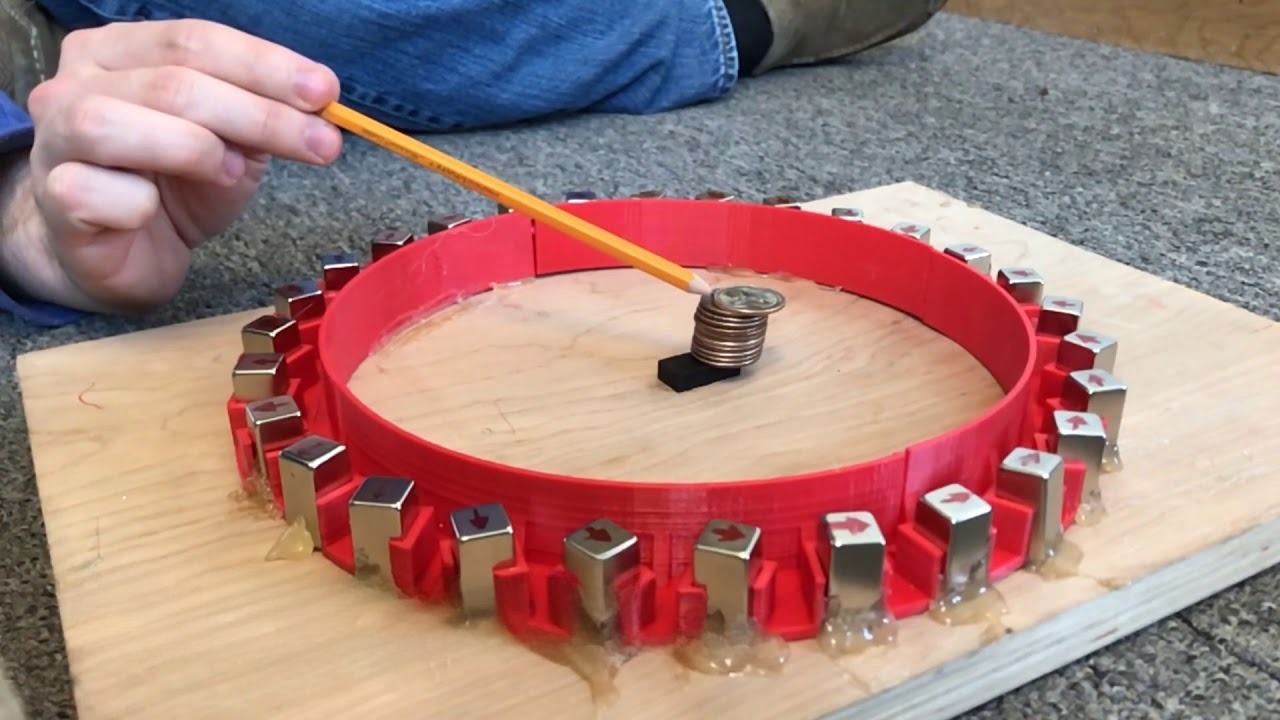
Circular arrays: Need even numbers for symmetry. Popular configurations include:
- 8 magnets (basic ring)
- 16 magnets (high-performance ring)
- 24 or 32 magnets (precision applications)
The key?
Circular arrays require magnets in multiples of 4 to maintain the proper orientation pattern.
Cost vs. Performance Analysis
Let’s talk money.
Neodymium magnets aren’t cheap. So how many do you really need?
Here’s my breakdown:
4-6 magnets: Proof of concept only. Minimal cost ($10-20) but limited practical use.
8-12 magnets: Educational and small projects. Moderate cost ($30-50) with good demonstration value.
16-24 magnets: Serious applications. Higher investment ($80-150) but professional-grade results.
32+ magnets: Industrial/research use. Significant cost but maximum performance.
The reality is:
Doubling your magnet count doesn’t double the field strength. But it does improve uniformity and extend the effective field area.
Real-World Examples
Let me share some specific applications:
Refrigerator magnets: Use continuous flexible arrays (technically infinite tiny magnets)
Halbach array motors: Typically 8-16 magnets per rotor
Magnetic bearings: Often employ 12-24 magnets
Research equipment: Can use 100+ precisely aligned magnets
Each application optimizes the magnet count for its specific needs.
Assembly Tips for Different Quantities
Building these arrays isn’t trivial.
Here’s what changes with quantity:
4-8 magnets: Manageable by hand with basic tools. Use non-magnetic spacers.
12-16 magnets: Requires a jig or fixture. The forces become substantial.
20+ magnets: Definitely need specialized assembly equipment. Safety becomes critical.
Warning: The repulsive forces between improperly oriented magnets are no joke. Always wear safety glasses and work methodically.
The Efficiency Equation
Here’s an interesting fact:
The effectiveness of your Halbach array follows a curve.
- First 4 magnets: Establish the basic effect
- Next 4 magnets: Roughly 40% improvement
- Additional sets: Diminishing returns
This means:
8-12 magnets often provide the best bang for your buck.
Going beyond that makes sense only when you need:
- Larger field area
- Better uniformity
- Specific geometric requirements
Making Your Decision
So how many magnets should YOU use?
Ask yourself:
- What’s your application? Different uses have different optimal counts.
- What’s your budget? More magnets = more cost (obviously).
- What’s your experience level? Start small and work up.
- What are your performance requirements? Precision applications need more magnets.
For most first-time builders, I recommend starting with 8 magnets. It’s enough to see impressive results without overwhelming complexity.
Advanced Configurations
Ready to level up?
Consider these advanced setups:
Variable field arrays: Use two concentric rings (16-24 magnets total) to adjust field strength.
3D Halbach spheres: Require 20+ magnets but create incredible field patterns.
Segmented arrays: Allow field shaping with strategic gaps between magnet groups.
Each configuration has its own optimal magnet count.
The Future of Halbach Arrays
The technology keeps evolving.
Current trends show:
- Micro-arrays using hundreds of tiny magnets
- Printed magnetic materials creating continuous Halbach patterns
- Smart arrays with adjustable orientations
These developments might change how we think about magnet quantities entirely.
Key Takeaways
Let’s wrap this up.
How many magnets are needed for a Halbach array?
- Minimum: 4 magnets
- Recommended: 8-12 magnets
- Optimal: Depends on your specific application
The beauty of Halbach arrays is their scalability. Whether you’re building a small demonstration with 8 magnets or an industrial system with hundreds, the principles remain the same.
Start with what you need. Build what you can handle. And remember – even a basic 8-magnet array can produce impressive results that seem to defy conventional magnetic behavior.
That’s the magic of the Halbach array. And now you know exactly how many magnets you need to create your own.