
Magnetic separation in mineral processing is one of those techniques that sounds complicated but is actually pretty straightforward once you break it down.
Here’s the deal:
It’s basically using magnets to pull valuable minerals away from worthless rock. And when done right, it can transform a pile of crushed ore into concentrated treasure.
As a professional magnetic drum separator manufacturer, I’ve spent years digging into mineral processing techniques, and magnetic separation keeps coming up as one of the most cost-effective methods out there. Why? Because unlike chemical processes that need expensive reagents, magnetic separation just needs… well, magnets.
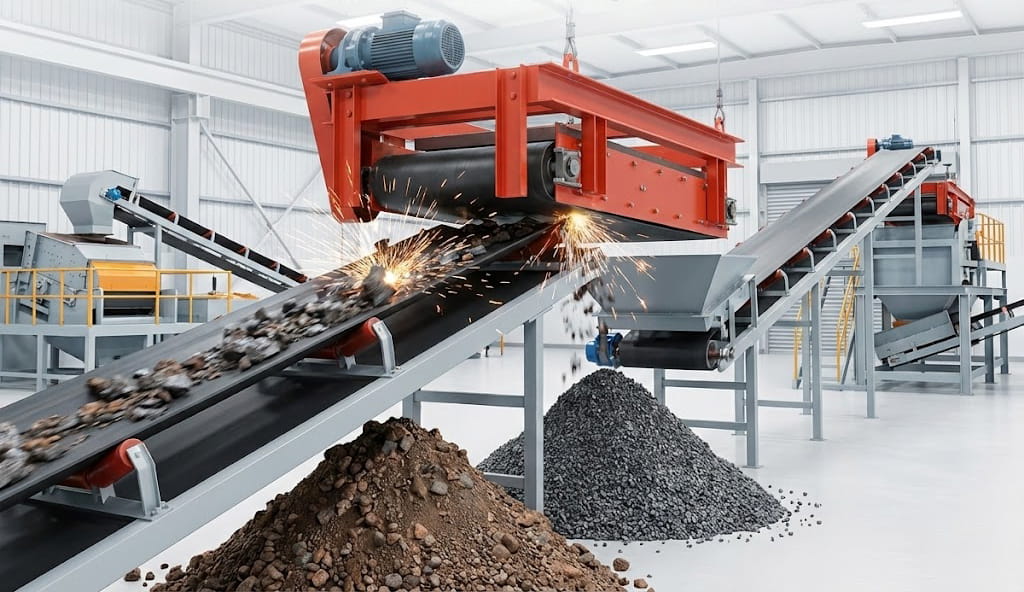
Table of Contents
What Is Magnetic Separation (And Why Should You Care)?
Think of magnetic separation like a super-powered recycling sorter.
You’ve got a mix of materials – some magnetic, some not. Run them past a magnet, and boom: the magnetic stuff sticks while everything else keeps moving.
In mineral processing, we’re talking about separating valuable magnetic minerals (like magnetite or hematite) from non-magnetic gangue materials.
The best part?
It’s a physical process. No nasty chemicals. No environmental headaches. Just pure physics doing the heavy lifting.
The Science Behind Magnetic Separation
Now let’s get into the nitty-gritty of how this actually works.
Every mineral has something called magnetic susceptibility – basically how much it wants to party with a magnet.
There are three main types:
Ferromagnetic Minerals
These are your magnet-loving minerals like magnetite. They’re strongly attracted to magnetic fields and are the easiest to separate. We’re talking about minerals that practically jump onto the magnet.
Paramagnetic Minerals
Think of these as the “maybe I’ll come to the party” minerals. They’re weakly attracted to magnets – minerals like hematite, ilmenite, and chromite. You need stronger magnetic fields to convince them to separate.
Diamagnetic Minerals
These are the party poopers. Materials like quartz actually get repelled by magnetic fields (though very weakly). They’re basically the non-magnetic waste you want to get rid of.
Types of Magnetic Separators That Actually Work
Here’s where things get interesting.
Not all magnetic separators are created equal. The type you need depends on what you’re trying to separate.
Low Intensity Magnetic Separation (LIMS)
This is your workhorse for strongly magnetic materials.
LIMS uses permanent magnets or low-power electromagnets to pull out ferromagnetic minerals. It’s perfect for:
- Magnetite recovery
- Removing tramp iron from ore streams
- Protecting downstream equipment from metal contamination
The magnetic field strength? Usually under 2,000 gauss. That’s enough to grab strongly magnetic materials without breaking a sweat.
High Intensity Magnetic Separation (HIMS)
When LIMS isn’t cutting it, you bring in the big guns.
HIMS cranks up the magnetic field strength to 10,000-20,000 gauss. Now we’re talking serious pulling power for those weakly magnetic minerals.
Perfect for:
- Ilmenite separation
- Upgrading iron ore
- Processing beach sands
- Extracting rare earth minerals
Rare Earth Roll Separators
These bad boys use neodymium magnets – the strongest permanent magnets on the planet.
I’ve seen these separators work magic on materials other equipment couldn’t touch. They’re especially good for:
- Fine particle separation (down to 75 microns)
- Silica sand purification
- Removing iron contamination from ceramics
- Glass recycling applications
Real-World Applications That Make Bank
Let me show you where magnetic separation really shines in mineral processing operations.
Iron Ore Processing
This is the bread and butter of magnetic separation.
Take a low-grade iron ore with 30% iron content. Run it through magnetic separation, and suddenly you’ve got a 65% iron concentrate. That’s the difference between worthless rock and profitable product.
One operation I studied boosted their iron recovery from 70% to 95% just by optimizing their magnetic separation circuit. At today’s iron prices, that’s millions in additional revenue.
Rare Earth Processing
Here’s where things get really lucrative.
Rare earth minerals are notoriously difficult to process. But many rare earth-bearing minerals (like monazite) are paramagnetic.
Using HIMS, processors can:
- Pre-concentrate rare earth ores
- Reduce downstream processing costs
- Improve overall recovery rates
Industrial Minerals
This might not sound sexy, but it’s where magnetic separation really pays the bills.
Take silica sand for glassmaking. Even tiny amounts of iron contamination can ruin an entire batch of glass. But run that sand through a magnetic separator? You’ve got ultra-pure product commanding premium prices.
Same goes for:
- Feldspar for ceramics
- Kaolin for paper
- Talc for cosmetics
The Economics of Magnetic Separation
Let’s talk money.
The beauty of magnetic separation? Low operating costs.
Here’s a typical breakdown:
- Power consumption: $0.50-2.00 per ton
- Maintenance: $0.20-0.50 per ton
- Labor: Minimal (often one operator per shift)
Compare that to flotation (which needs expensive chemicals) or gravity separation (which needs tons of water), and magnetic separation starts looking pretty attractive.
Optimizing Your Magnetic Separation Process
Want to squeeze every last percent of recovery from your magnetic separator?
Here’s what actually moves the needle:
Particle Size Matters
Too coarse, and you get poor liberation. Too fine, and particles don’t respond well to magnetic fields.
The sweet spot? Usually between 0.1mm and 10mm, depending on your ore.
Feed Rate Is Critical
Overload your separator, and recovery tanks. I’ve seen operations boost recovery by 15% just by dropping their feed rate by 20%.
It’s counterintuitive, but processing less material per hour often means more valuable product at the end of the day.
Magnetic Field Configuration
This is where the magic happens.
Modern separators use complex magnetic field patterns to maximize separation efficiency. We’re talking about:
- Alternating pole configurations
- Variable field gradients
- Pulsating magnetic fields
Get this right, and you can separate minerals that are almost magnetically identical.
Common Mistakes (And How to Avoid Them)
After years in this industry, I’ve seen every mistake in the book.
Mistake #1: Wrong Equipment Selection
Using LIMS for weakly magnetic minerals is like bringing a knife to a gunfight. Know your ore, choose your weapon.
Mistake #2: Ignoring Liberation Size
No magnetic separator can separate locked particles. If your valuable minerals are still attached to gangue, all the magnetic force in the world won’t help.
Mistake #3: Poor Maintenance
Magnetic separators are robust, but they’re not indestructible. Worn drums, damaged belts, and weakened magnets kill efficiency.
Future Trends in Magnetic Separation
The field isn’t standing still. Here’s what’s coming down the pipeline in 2025 and beyond:
Superconducting Magnets
Imagine magnetic fields 10x stronger than today’s best separators. That’s what superconducting technology promises. Early trials show recovery improvements of 20-30% for difficult ores.
AI-Optimized Separation
Machine learning algorithms are starting to optimize separator settings in real-time based on feed characteristics. This could boost efficiency by 10-15% without any hardware changes.
Dry Magnetic Separation
Water is becoming scarce in many mining regions. New dry separation technologies are achieving wet separation performance without a drop of water.
Getting Started with Magnetic Separation
Ready to implement magnetic separation in your operation?
Start with these steps:
- Analyze your ore – Get detailed magnetic susceptibility data
- Run bench-scale tests – Start small before investing big
- Calculate the economics – Include all costs and benefits
- Choose the right equipment – Match the separator to your specific needs
- Optimize continuously – Small improvements add up to big gains
The Bottom Line
Magnetic separation might not be the newest technology in mineral processing, but it’s one of the most reliable and cost-effective.
When you’re dealing with magnetic minerals, it’s often the difference between a profitable operation and a money pit.
The key is understanding your ore, choosing the right equipment, and optimizing relentlessly.
Get it right, and magnetic separation in mineral processing becomes your secret weapon for turning low-grade ore into high-grade profit.