
How Many Magnets Are Needed for a Halbach Array?
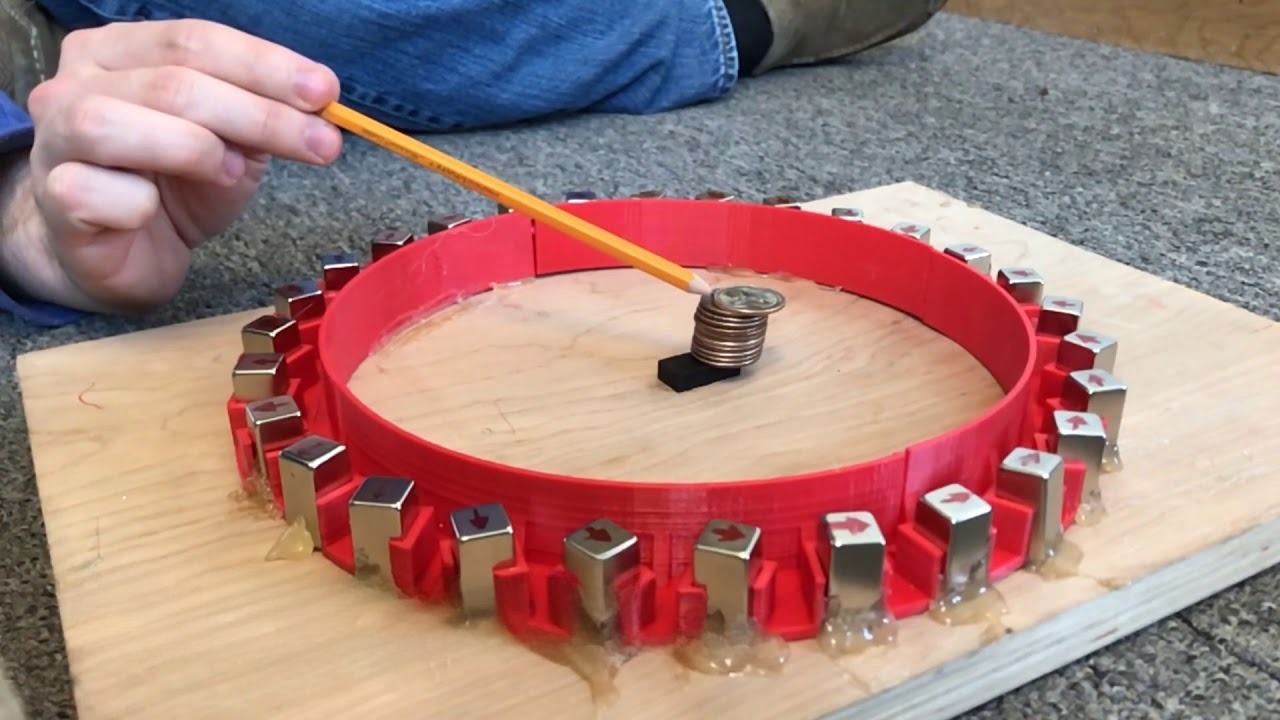
A Halbach array can technically work with as few as 4 magnets. But most practical applications use 8 or more for optimal performance.
How Many Magnets Are Needed for a Halbach Array? Read More »
A Halbach array can technically work with as few as 4 magnets. But most practical applications use 8 or more for optimal performance.
How Many Magnets Are Needed for a Halbach Array? Read More »
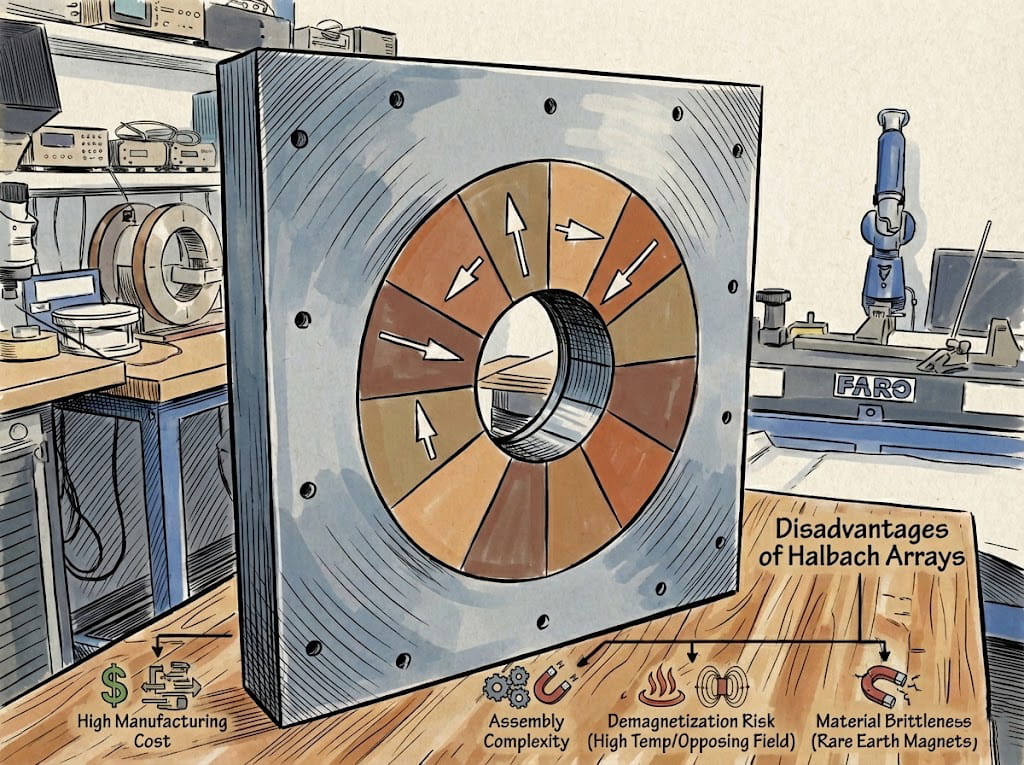
Halbach arrays have critical drawbacks: complex assembly, self‑demagnetization, heat sensitivity, high cost, and limited use cases. Learn when to avoid them.
What Are the Disadvantages of Halbach Arrays? 5 Realistic Drawbacks Read More »
Discover what is the principle of Halbach array – a 90-degree magnet rotation creating 2x stronger fields on one side. Used in maglev trains, motors, and even fridge magnets.
What Is the Principle of Halbach Array? Read More »
For most Halbach arrays, a two-part structural epoxy delivers the required shear strength and gap-filling. Learn top adhesive choices, critical surface-prep, curing rules, risks, and recommended reinforcement paths.
Best Glue for a Halbach Array: Recommendations, Risks, and Application Steps Read More »
Halbach arrays concentrate flux on one side but are difficult to build. Learn the five main assembly challenges (repulsion, snap risk, torque, adhesives, precision), real-world techniques, common mistakes, when to hire pros, and practical recommendations for safer, higher‑success assembly.
Why Are Halbach Arrays So Hard to Assemble? 5 Main Challenges and Practical Paths Read More »
Halbach arrays concentrate up to ~95% of field on one side and can boost flux density (e.g., 579 mT → 833 mT) and power density vs normal arrays, but cost, assembly complexity and high‑temperature demagnetization are key limits. Use Halbach for weight- and efficiency-critical systems; use normal arrays where cost and manufacturing simplicity matter.
Halbach Array vs Normal Array: Performance, Risks, and Recommended Use Cases Read More »
Yes — Halbach arrays are permanent magnets arranged to concentrate field on one side and cancel it on the other. Learn practical limits, common failure modes (tolerance, mechanical forces, temperature), recommended selection steps (specify field, simulate, prototype, partner with experts) and which array type fits motors, MRI, maglev or generators.
Are Halbach Arrays Permanent Magnets? Practical Risks, Limits and How to Choose Read More »
Compare the three main magnetic coupling types (synchronous, eddy‑current, hysteresis) and common structures (face‑to‑face, coaxial, tubular). Includes a 5‑step selection framework, key limitations and common mistakes to help you pick a safe, low‑maintenance solution for chemical, food, renewable energy, and medical applications.
Magnetic Coupling Types and Selection Essentials (Risks & Limits Highlighted) Read More »
In this post, as a professional magnetic drum manufacturer, I will share 7 key advantages of magnetic drums!
Advantages of Magnetic Drum: 7 Key Benefits Read More »
As a professional magnetic drum separator manufacturer, I’ve spent years digging into mineral processing techniques, and magnetic separation keeps coming up as one of the most cost-effective methods out there. Why? Because unlike chemical processes that need expensive reagents, magnetic separation just needs… well, magnets.
Magnetic Separation in Mineral Processing: The Complete Guide Read More »