Look, I’ll be honest with you.
When I first heard about “magnet fishing,” I thought it was some weird new way to catch actual fish. You know, like those magnetic fishing toys we played with as kids?
Turns out, I couldn’t have been more wrong.
Magnet fishing is something way cooler. And in this guide, as a professional fournisseur d'aimants de pêche, I’m going to show you exactly what fishing magnets are used for, how they work, and why this hobby has exploded in popularity over the last few years.
Plongeons dans le vif du sujet.
What Are Fishing Magnets? (The Simple Answer)
A fishing magnet is a powerful neodymium magnet attached to a rope used for retrieving metal objects from bodies of water.
Think of it as metal detecting… but wetter.
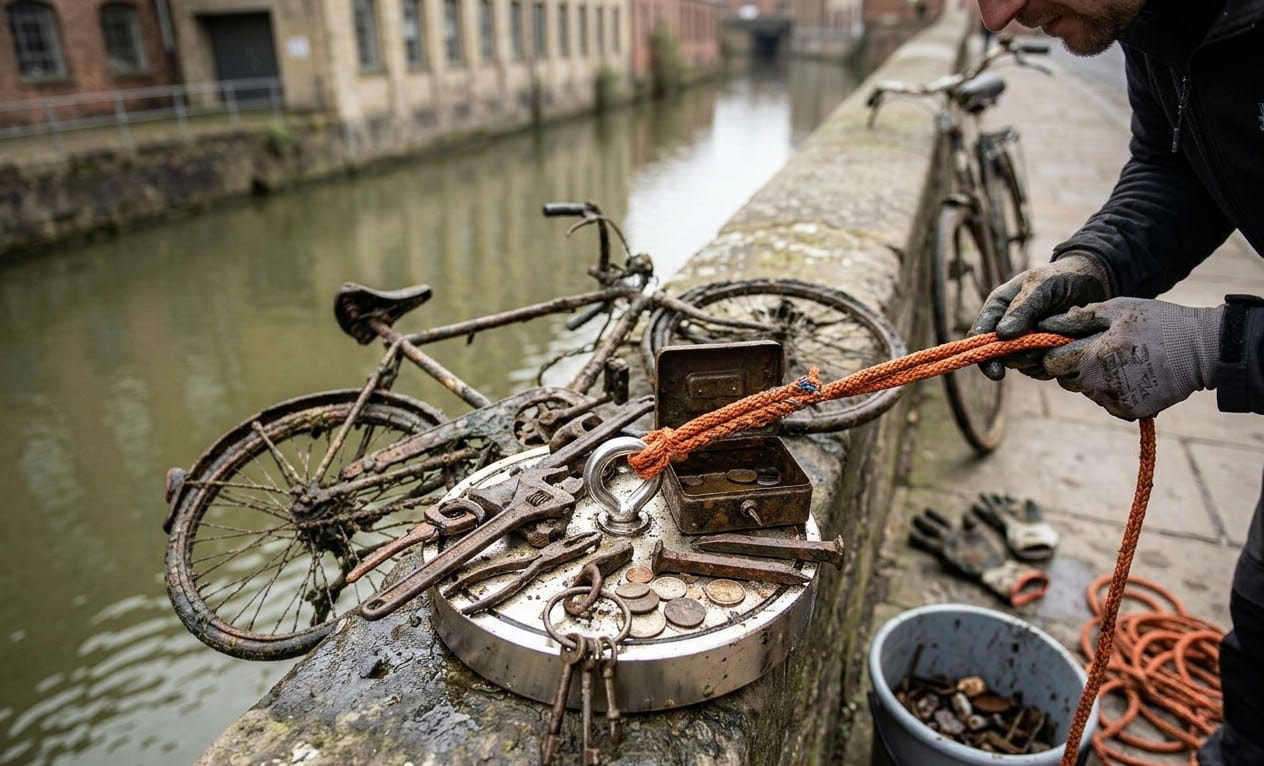
You toss the magnet into a river, lake, or canal. You drag it along the bottom. And when it latches onto something metal? You pull it up and see what you’ve found.
C'est simple, non ?
Mais voilà : à quoi servent les aimants de pêche goes way beyond just pulling random junk out of the water. Let me break down the main uses.
The 9 Surprising Ways People Use Fishing Magnets
1. Treasure Hunting (The Obvious One)
This is what most people think of when they ask “what are fishing magnets used for.”
Magnet fishers pull up all kinds of stuff:
- Bicycles (seriously, so many bikes)
- Old safes
- Tools and equipment
- Coins and jewelry
- Fishing gear (hooks, sinkers, lures)
- Objets historiques
- Occasionally… weapons
I talked to one magnet fisher who pulled a Civil War-era cannonball from a river in Virginia. Another guy found a motorcycle from the 1970s.
The bottom line? You never know what’s sitting at the bottom of your local waterway.
Conseil de pro : Old bridges, docks, and swimming holes are magnet fishing GOLDMINES. People have been dropping stuff off these structures for decades.
2. Environmental Cleanup (The Responsible One)
Voici quelque chose d'intéressant :
Magnet fishing isn’t just about finding treasure. It’s also about removing pollution from our waterways.
Think about it.
Every rusty bike frame, every discarded shopping cart, every chunk of scrap metal sitting at the bottom of a river is leaching who-knows-what into the water.
And magnet fishers pull this stuff out by the ton.
In fact, there’s a whole community of magnet fishers who document their cleanup hauls on YouTube. They’re literally making waterways cleaner, one magnet toss at a time.
The environmental impact is real:
- Removes toxic metal waste
- Improves water quality
- Makes waterways safer for wildlife
- Prevents sharp metal hazards for swimmers and boaters
3. Underwater Salvage Operations (The Professional One)
Voici quelque chose que la plupart des gens ne réalisent pas :
Fishing magnets aren’t just for hobbyists.
Professional salvage teams use them too.
Let’s say a construction crew drops an expensive tool into a murky river. Or a shipping company loses a container full of metal parts overboard.
Sending divers down is expensive. Sometimes impossible.
But a powerful fishing magnet on a rope? That can save the day.
Salvage professionals use fishing magnets to:
- Recover dropped equipment
- Locate underwater metal objects before diving
- Assist in wreckage recovery
- Support archaeological dives in murky water
4. Industrial and Construction Sites
Walk onto any construction site and you’ll see the problem:
Tools get dropped. ALL THE TIME.
And when they fall into muddy water, deep trenches, or hard-to-reach areas, getting them back seems impossible.
Enter the fishing magnet.
Construction workers keep these things handy for:
- Retrieving dropped tools from deep trenches
- Pulling metal debris out of excavated areas
- Cleaning up metal waste before backfilling
- Finding lost equipment in muddy conditions
One construction foreman told me his crew saved over $5,000 in replaced tools in a single year just by using a fishing magnet.
5. Maritime and Boating Scenarios
Boaters lose stuff overboard. It’s just a fact of life.
Phones. Tools. Fishing gear. Expensive equipment.
And here’s the problem:
Most bodies of water are murky. You can’t see the bottom. That $800 trolling motor you just dropped? It’s gone forever.
Unless you have a fishing magnet.
Maritime professionals use fishing magnets for:
- Recovering overboard tools and equipment
- Cleaning metal debris from boat ramps
- Locating lost anchors
- Assisting with boat repairs (dropped tools happen)
6. Law Enforcement and Security
This one might surprise you.
But law enforcement agencies actually use fishing magnets for investigations.
Pensez-y :
When someone disposes of evidence in a river or lake, how do you find it?
You can’t see through murky water. Dragging the bottom with hooks damages potential evidence.
But a powerful magnet? That can locate metal objects without destroying them.
Law enforcement uses fishing magnets for:
- Recovering firearms and weapons
- Finding discarded knives or tools
- Locating metal evidence in cold cases
- Search and rescue operations
I’ve seen multiple news stories about police departments recovering murder weapons using nothing more than a strong magnet and a rope.
7. Home and Personal Use
You don’t need to be a professional to find fishing magnets useful around the house.
Here are some real-world examples:
Lost your keys in a pond? Fishing magnet.
Dropped your expensive drill in a muddy ditch? Fishing magnet.
Can’t find that wrench you dropped while working on your dock? Fishing magnet.
Need to clean metal shavings out of your garage floor cracks? Fishing magnet wrapped in a plastic bag (then pull the bag over the shavings to release them).
One guy told me he used his fishing magnet to retrieve his wedding ring from a lake. He’d taken it off to wash his hands, dropped it off the dock, and fished it out ten minutes later.
8. Educational and Scientific Research
Here’s a use you probably haven’t considered:
Fishing magnets are teaching tools.
Physics teachers use them to demonstrate magnetic fields, attraction forces, and electromagnetic principles.
Environmental scientists use them to sample metal pollution in waterways.
Researchers use them to study how metal particles move through aquatic ecosystems.
It’s hands-on science at its best.
9. DIY and Crafting
And finally, the creative use:
Artists and crafters have discovered fishing magnets.
They use them to:
- Create magnetic sculptures
- Incorporate found metal objects into artwork
- Build magnetic closures for custom projects
- Manipulate metal pieces during crafting
One artist I know uses fishing magnets to pull metal objects from rivers, then incorporates those rusted pieces into her mixed-media art. The objects come with built-in history.
How Strong Are Fishing Magnets?
Now, if you’re wondering how strong fishing magnets actually are, let me share some data.
We tested our fishing magnets here at the lab. And the results might surprise you.
Voici ce qu'il en est :
The listed pull force (like “500 lb magnet”) assumes the magnet is stuck to a large, flat, dry steel plate. That’s the force needed to pull it straight off.
But real-world magnet fishing? It’s different.
| Aimant de pêche | Listed Strength | Steel Rod | Thin Steel | Wrench |
|---|---|---|---|---|
| FM1-48 | 230 lb | 24.2 lb | 10.2 lb | 57.2 lb |
| FM1-60 | 400 lb | 28.4 lb | 11.8 lb | 43.8 lb |
| FM1-75 | 500 lb | 30.8 lb | 12.2 lb | 44.8 lb |
Wait a second…
Why does the weaker 230 lb magnet outperform the 500 lb magnet on the wrench?
Great question.
Voici pourquoi :
The magnetic field is strongest at the edges of the magnet, not the center. The smaller magnet’s edges were closer to the wrench contact points.
Magnetic fields are complicated.
10 Factors That Affect Fishing Magnet Strength
Before you buy a fishing magnet, you need to understand this:
Your magnet will almost NEVER perform at its listed strength in the real world.
Voici pourquoi :
1. Magnet Strength
Obviously, stronger magnets pull harder. But as we saw above, bigger isn’t always better depending on what you’re grabbing.
2. Magnet Size
Smaller magnets can sometimes outperform larger ones on small objects because their edge fields align better with the object.
3. Attracting Object Size
A 500 lb magnet won’t give you 500 lbs of pull on a wrench. The object needs to be big enough to absorb all those magnetic flux lines.
4. Gap Between Magnet and Object
Mud, sand, seaweed, or just water between the magnet and metal? Pull strength PLUMMETS. Even a 1/16″ gap can cut strength by 70%.
5. Leverage
You’re rarely pulling straight up. Angled pulls reduce holding force significantly.
6. Water Resistance
Water has weight. Lifting an object through water adds resistance that can pull it off your magnet.
7. Moving Water
Currents create drag. The magnet has to work harder to hold on.
8. Friction
Mud on your magnet? Slippery surface? Objects slide off easier.
9. Rope Dynamics
Your rope angle affects leverage. An unstable rope makes it harder to maintain good contact.
10. Surface Contact
Are you getting full, flat contact? Probably not. Most grabs are partial or angled.
Single-Sided vs. Double-Sided Fishing Magnets
When you start shopping for fishing magnets, you’ll notice two main styles:
Single-Sided Magnets (FM1 Style)
The eye bolt is on TOP. One magnetic face.
Meilleur pour :
- Dropping straight down from docks and bridges
- Lifting heavy objects with minimal leverage
- Pier fishing where you control the angle
Double-Sided Magnets (FM2 Style)
The eye bolt is on the SIDE. Both faces are magnetic.
Meilleur pour :
- Dragging along the bottom
- Moving water where objects come from any angle
- Maximum versatility
We tested the double-sided magnets too:
| Aimant de pêche | Listed Strength | Leverage Pull | Slide Force |
|---|---|---|---|
| FM2-48 | 230 lb | 53.8 lb | 47.6 lb |
| FM2-60 | 400 lb | 93.6 lb | 82.8 lb |
| FM2-75 | 500 lb | 117 lb | 103.5 lb |
Notice something?
Real-world performance is much lower than listed strength. That’s why understanding à quoi servent les aimants de pêche in practical terms matters more than chasing big numbers.
La pêche à l'aimant en vaut-elle la peine ?
This is the question I get most often.
And here’s my honest answer:
It depends.
If you enjoy:
- Outdoor exploration
- Le plaisir de la découverte
- Environmental conservation
- A low-cost hobby
- Meeting interesting people in the community
Then yes, magnet fishing is absolutely worth trying.
But if you’re expecting to pull up treasure every time? You’ll be disappointed.
Most magnet fishing trips yield junk. Old scrap metal. Rusted parts. Trash.
But that one trip where you pull up something amazing? That’s what keeps people hooked.
Magnet Fishing Safety (Don’t Skip This)
I’m not going to sugarcoat it:
Fishing magnets can be dangerous.
Here’s what you need to know:
1. Magnets Are STRONG
Those neodymium magnets can pinch skin severely. Keep fingers clear when attaching to metal.
2. Wear Gloves
Heavy-duty gloves. The stuff you pull up is often sharp, rusty, and covered in who-knows-what.
3. Use Strong Rope
Cheap rope breaks. Then your expensive magnet is gone forever. Use rated rope appropriate for your magnet’s pull force.
4. Handle Finds Carefully
Rusty metal can cause tetanus. Sharp edges cut through gloves. And sometimes people pull up unexploded ordnance or other hazardous items.
5. Report Weapons or Dangerous Items
If you pull up a gun, knife used in a crime, or anything suspicious? Call the police. Don’t touch it further.
6. Know the Laws
Magnet fishing isn’t legal everywhere. Some areas require permits. Others prohibit it entirely. Research local regulations before you go.
My Personal Magnet Fishing Recommendations
After researching this topic extensively, here’s my advice:
Start with a double-sided magnet in the 300-400 lb range.
Pourquoi ?
Double-sided gives you more versatility. And 300-400 lbs is strong enough to pull up interesting finds but not so strong that you’ll get permanently stuck on a submerged car.
Buy from reputable sources.
Cheap magnets from random sellers often have inflated strength ratings. Stick with established magnet companies.
Join the community.
There are magnet fishing forums, Facebook groups, and YouTube channels everywhere. Learn from experienced fishers. Share your finds. Get advice on good locations.
Be patient.
Your first few trips might yield nothing but rusty nails. That’s normal. Keep at it.
Le bilan
So à quoi servent les aimants de pêche?
They’re used for adventure. For discovery. For cleaning up our waterways. For recovering lost treasures. For science. For art. And sometimes, for helping law enforcement solve crimes.
It’s a simple concept—a magnet on a rope—that opens up a world of possibilities.
And honestly?
That’s what I love about it.
In a world of complicated technology and expensive hobbies, magnet fishing is beautifully simple. You toss a magnet in the water. You pull up whatever’s down there. And you never know what you’ll find.
If that sounds interesting to you, grab a magnet and give it a shot.
Just remember: understanding what are fishing magnets used for is the first step. Getting out there and actually doing it? That’s where the real fun begins.
Have you tried magnet fishing? Found anything interesting? Drop me a comment below—I’d love to hear your stories.