
Grundkenntnisse über die Entstehung des Entmagnetisierungseffekts

Faktoren, die eine Entmagnetisierung des Magneten verursachen, und wie man sie vermeiden kann.

A hotly debated question in the magnet industry: Will permanent magnets demagnetize, i.e. lose their magnetism? Although permanent magnets should theoretically be able to maintain their magnetism for hundreds of years without external influences.
However, magnets used in practical applications will face various complex external environments and cause demagnetization. Now, let me take you through the main factors that may cause demagnetization and how to control them to minimize demagnetization to determine the grade of permanent magnets required for your application.

The Cause of Magnetism.

Magnets can pick up paper clips and drive motors to rotate. The roots of these magical abilities are actually hidden in the microscopic world. Before wir begin analyzing demagnetization, let’s review the causes of magnetization.
In materials such as iron, nickel or neodymium, which make up permanent magnets, each atom of the substance contains electrons with an electrical charge. When a magnetic material’s electrons are introduced into the substance’s magnetic field or an electric current is applied, they spin in well-aligned patterns, forming microscopic magnetic regions called “domains.” When these domains are aligned, their collective power creates the magnetic field we perceive. Think of it like a group of people cheering in unison – the louder (or stronger) the cheers, the stronger the collective effect.
But not all materials can maintain this formation. Over time, magnets will tend to reduce this energy state and eventually become demagnetized. For example, when the external magnetic field of pure steel disappears, its induced field will immediately reduce to zero. Only ferromagnetic materials (such as iron, cobalt, or neodymium iron boron) can maintain strong magnetism for a long time because their magnetic domains are “locked” in a fixed position – unless they encounter high temperatures, reverse magnetic fields, or severe impact. This stability is partially reflected in the hysteresis curve (which we will analyze in detail in another guide), which reveals the material’s ability to resist demagnetization.

What is the Demagnetizing Field?

Now, here’s where things get tricky. Even a perfectly magnetized object is in an invisible battle with itself. When the raw magnet material is exposed to an external magnetic field during the manufacturing process, its internal magnetic domains align, creating a strong magnetization (M). However, once the external field is removed, the magnet’s own shape and structure creates an internal opposing magnetic field (Hₑ) that weakens its overall magnetism. The north and south poles inside the material push against each other, fighting against their own alignment. The longer or flatter the magnet, the stronger this self-destructive effect.
Let me put it in a simpler way: hold two identical magnets with their north poles facing each other. They push against each other, right? Now imagine a single bar magnet—its own north and south poles are constantly trying to repel each other from the inside, reducing its net magnetic field strength. This is essentially the effect of the demagnetization field.
The figure below shows a comparison of the magnetic field (magnetic flux density) B, the demagnetization field H, and the magnetization M of a cylindrical bar magnet. The north pole is on the right and the south pole is on the left.
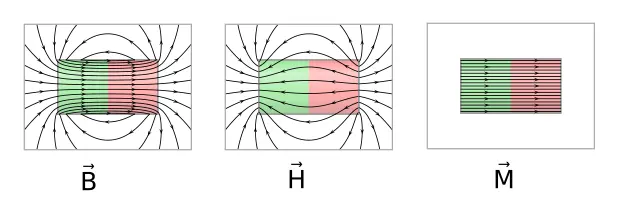
Magnet internal and external magnetic field

This explains why the magnetic force of magnets in the shape of thin discs of the same material is always weaker than that of long magnets – the former has a larger demagnetization factor and a more obvious self-cancellation effect.

Principles of magnetostatics

According to the magnetostatic equation in Maxwell’s equations, the demagnetization field is a function of the position H ( r ). In the actual magnetization process, the external magnetic field suppresses the demagnetization field, and the magnetic domains are quickly aligned (the magnetic susceptibility χ is very high at this time)
When the magnetization intensity M reaches a certain critical point, the demagnetization field intensity Hₑ begins to compete with the external magnetic field H₆, and the magnetization process becomes difficult.
Adhere to continuous magnetization, and according to Ampere’s law and Gauss’ law, the final actual magnetic field strength is B = μ₀(H + M).

Ampere's law and Gauss's law

*μ₀ is the vacuum permeability, and M is the magnetization intensity.

The magnetic field strength H consists of two parts:

  • External magnetic field (H₆): externally applied magnetizing force
  • Demagnetization field (Hₑ): internal reaction force caused by the shape of the material itself

The formula is: H = H₆ – Hₑ
The energy of the demagnetization field is completely determined by the integral of the volume V of the magnet:

Energy formula of the demagnetization field

The demagnetization field here is like a “rebel molecule” inside the magnet, always trying to offset the external magnetization effect. Its strength is determined by the demagnetization factor (N)* of the material, which is closely related to the shape of the object – the N value of a spherical magnet is 1/3, while a slender bar may be as low as 0.02.

Factors causing magnet demagnetization.

Although permanent magnets can usually maintain their continuous magnetic field for a long time under normal working conditions. However, in reality, permanent magnetic materials will still demagnetize under certain conditions, such as exposure to high temperatures, volume loss caused by collisions, and exposure to conflicting magnetic fields. ——Our testing department has recorded and analyzed hundreds of failed magnets and found that these 6 “invisible killers” are always behind demagnetization.

  • High temperature: the “fuse” of magnetic force

    High-temperature demagnetization method

    Heat has always been the number one enemy of magnetic force. Every magnet has a maximum operating temperature and a Curie temperature. Exceeding either temperature, the magnet may lose some or all of its magnetism. For example, standard neodymium magnets (such as N52) will begin to weaken above 80°C. If the temperature continues to rise, the internal magnetic domains will begin to permanently misalign. Once misaligned, they cannot recover on their own. The limit temperature of samarium cobalt magnets is 350°C. Alnico magnets have the best temperature characteristics of any standard production magnet material and are capable of continuous duty applications with expected temperatures up to 540°C, but are more expensive.
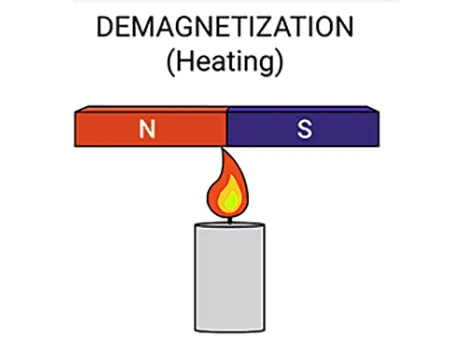
    This usually happens in high-speed motors, welding devices, or outdoor equipment exposed to direct sunlight or high temperatures. Last summer, a neodymium magnet rotor of a motor manufacturer in Zhejiang suddenly lost magnetism during testing. After investigation, it turned out that the local temperature soared to 210°C (close to the Curie temperature of neodymium magnets) due to defects in the heat dissipation design.
    If the magnet needs to work in a high-temperature environment, be sure to choose a high-temperature grade material, such as N42SH, N35EH or SmCo, which can better withstand high temperatures. (Click to learn more about the characteristics of magnet grades) When selecting magnetic materials, the actual operating temperature should be lower than 80% of the Curie temperature. When real-world applications involve temperature fluctuations, you can’t just look at peak temperatures, but also look at sustained exposure over time. If necessary, use coating protection (such as epoxy resin + nickel copper nickel three-layer plating).
  • Reverse magnetic field: “shuffler” of magnetic domains
    Exposure to an adverse external magnetic field can cause permanent magnets to demagnetize. When there is a strong magnetic field around a magnet that is opposite to its magnetic orientation, the magnetic field will form a demagnetizing force that pulls its internal magnetic domains in a new direction, silently causing the magnet’s performance to degrade. For example, the magnetic field of other nearby magnets, electromagnetic coils, or industrial equipment.
    It is therefore very important to store permanent magnets correctly and avoid placing strong magnets too close without proper shielding. High coercivity materials are preferred (such as N52 neodymium magnets with Hcj up to 1114 kA/m). When assembling magnetic components on a daily basis, ensure that the polarity of adjacent magnets is correctly connected in series. Of course, there are special cases – Halbach-Arrays, whose specific array method will cause static demagnetization fields for adjacent permanent magnets. Permanent magnetic torque couplings “slip” when rotating with magnets of the same pole. Under the combined effect of the relative and high temperature of the rotor, the magnet alloy is extremely susceptible to demagnetization.
  • Magnetic damage caused by physical impact

    Physical shock demagnetization method

    Magnets are fragile, especially neodymium magnets. If the magnet is hit by other objects or dropped, it may chip, crack, or break. Even tiny cracks (invisible to the naked eye) can disrupt the internal magnetic alignment and reduce strength.
    An auto parts manufacturer once complained that their magnetic oil pan screws frequently failed. We found through scanning electron microscopy that engine vibration caused microcracks inside the magnets – these cracks were like broken ends of magnetic field lines, causing the magnetic field strength to decay by 37% in three months. Later, we added a rubber cushion to the magnetic oil drain screw and the problem was solved.
  • Magnet Geometry:
    The geometry of a magnet can be reduced to a simple ratio – magnetic length / effective pole diameter (L/D). The pole length of a magnet is the physical size of the magnet in the direction of magnetization. The flatter the shape, the closer the internal poles are, and the stronger the self-cancelling effect. The higher the aspect ratio, the stronger the magnet’s ability to resist demagnetization. This is also the reason why magnets of the same material, thin magnets, sharp-angle magnets or smaller magnets are always easier to demagnetize than thick squares. So when designing custom magnets, work with experts who will consider aspect ratios, edge effects, and operating environments. Sometimes, a small change in geometry can greatly improve long-term performance.
    Eine Drohnenfabrik in Dongguan hat einmal 0,5 mm dünne Magnetbleche verwendet, um Gewicht zu sparen. Dies führte dazu, dass die gesamte Charge von Motoren aufgrund geomagnetischer Störungen ihren Magnetismus verlor. Später wurde eine 3 mm dicke mehrpolige Magnetisierungslösung verwendet, die die Kosten nur um 15% erhöhte, aber die Ausfallrate sank von 32% auf 1,7%.
    Leitfaden für die Formoptimierung
    FormAnwendbare SzenarienBereich des Entmagnetisierungsfaktors
    Ring/BogenMotorrotor, Sensor0.1-0.3
    Bildseitenverhältnis>3:1Magnetleiste, Lautsprecher-Magnetkreis0.02-0.1
    Dünnes BlattGeschlossener magnetischer Kreislauf Nur Anwendung0.7-0.95
  • Korrosion und Umwelteinflüsse
    Sie wissen vielleicht nicht, dass ein ein rostiger Magnet ist wie eine undichte Batterie - Unsere Vergleichstests haben ergeben, dass ein Neodym-Magnet durch Oberflächenrost 5-8% seines Magnetflusses pro Jahr verlieren kann. Insbesondere die Salzsprühnebelumgebung in Küstengebieten kann dazu führen, dass auf unbeschichteten Magneten innerhalb von drei Monaten Oxidationsflecken auftreten. Aus diesem Grund bestimmen wir die Beschichtung vor jeder Kundenbestellung. Erfahren Sie mehr über die vielfältigen Beschichtungsmöglichkeiten für Magnete.
  • Zeit und natürlicher Verfall
    Auch wenn Sie Ihre Magnete wie Schätze hüten, wird die Zeit ihre Spuren hinterlassen. Die meisten modernen Magnete (wie Neodym-Eisen-Bor und Samarium-Kobalt) sind sehr stabil, aber minderwertige Magnete oder alte Keramikmagnete verlieren mit der Zeit ihren Magnetismus - vor allem, wenn sie nicht richtig gelagert werden.
    Obwohl die Geschwindigkeit nicht sehr hoch ist, können sich die magnetischen Bereiche nach 10 bis 20 Jahren langsam entspannen, vor allem, wenn der Magnet nahe an seiner Koerzitivfeldstärkegrenze ist (der Punkt, an dem er dem Einfluss der Entmagnetisierung widerstehen kann).

Die Entmagnetisierung ist ein Problem, das bei der tatsächlichen Verwendung magnetischer Produkte auftritt. Das kann Zeit, Geld und Vertrauen kosten. Aber wenn Sie die Schlüsselfaktoren - Temperatur, externe Magnetfelder, Zeit, Stöße, Konstruktionsfehler, Korrosion und Handhabung - erst einmal verstanden haben, können Sie fundiertere Entscheidungen über die Auswahl von Magneten und die Gestaltung von Anwendungen treffen.

Wie kann man die Entmagnetisierung von Magneten vermeiden?

Seien wir ehrlich: Es gibt nichts Frustrierenderes, als einen starken, glänzenden Magneten zu kaufen und dann festzustellen, dass er geschwächt ist. Wenn wir verstehen, warum Magnete entmagnetisiert werden, stellt sich natürlich die Frage: Wie können wir das verhindern? Lagern Sie Magnete an einem trockenen, geschützten Ort. In der Magnettechnik ist die Aufrechterhaltung der Magnetfeldstabilität wie der Schutz einer Präzisionsuhr - jeder Schritt erfordert eine präzise Kontrolle. Wir haben die Normen der International Magnetic Materials Association (IMMA) und zwanzig Jahre Branchenerfahrung kombiniert, um dieses mehrschichtige Schutzsystem zu entwickeln.

Die Temperaturkontrolle ist die erste Verteidigungslinie.

Die Curie-Temperatur des gebräuchlichsten Neodym-Eisen-Bor-Magneten (NdFeB) liegt beispielsweise zwischen 80-230℃, aber die tatsächliche Sicherheitsschwelle muss um 20% gesenkt werden. Das bedeutet, dass die Oberflächentemperatur des Magneten im Dauerbetrieb streng kontrolliert werden sollte. Wenn Kunden planen, Magnete für Motoren oder Außensensoren zu verwenden, empfehle ich in der Regel, dass sie Magnete mit hoher Temperaturbeständigkeit wie N42SH oder Sm2Co17 wählen. Ein Ingenieur vernachlässigte einmal diesen Spielraum bei der Konstruktion des Antriebssystems eines Elektrofahrzeugs, was dazu führte, dass der Motor bei Dauersteigversuchen teilweise entmagnetisiert wurde. Durch den Einbau von Aluminiumoxid-Keramik-Kühlkörpern und Mikro-Wirbelstrom-Kühlrohren konnte die Hot-Spot-Temperatur schließlich um 35% gesenkt und die Schwächung des magnetischen Flusses von 1,2% auf 0,3% pro Monat reduziert werden.

Schutz vor magnetischen Feldern.

Die Bekämpfung von Störungen durch externe Magnetfelder erfordert einen zweigleisigen Ansatz. Die Koerzitivfeldstärke (Hcj), das “Anti-Interferenz-Gen” des Materials, bestimmt direkt seine Überlebensfähigkeit. Referenzformel:
Kritisches Entmagnetisierungsfeld Hₐ = Hcj × (1 - N) (N ist der Entmagnetisierungsfaktor, der von der Form des Magneten abhängt)
Beispielsweise erreicht die Koerzitivfeldstärke von Neodym-Magneten der Klasse N42SH 955 kA/m, was 42% höher ist als die des Basismodells N42. In der Praxis wird empfohlen, einen “dreischichtigen Schutz” zu verwenden: Vorrangig werden Materialien mit hohem Hcj-Wert als Kern verwendet, die äußere Schicht wird mit einer magnetischen Abschirmung aus reinem Eisen umhüllt, und schließlich wird eine Halbach-Anordnung zur Optimierung der Magnetfeldverteilung verwendet. Diese Struktur ist wie eine kugelsichere Weste für einen Magneten, und tatsächliche Messungen können externe Magnetfeldstörungen um 68% abschwächen. Wenn sich in Ihrem Arbeitsbereich viele Motoren, Spulen oder andere Magnete in unmittelbarer Nähe zueinander befinden, sollten Sie diese gut abschirmen.

Das Wesen des mechanischen Schutzes ist die Energieumwandlung.

Bei einem Aufprall auf einen Magneten verursacht die Schwingungsenergie Schäden auf zwei Arten: direkte strukturelle Schäden, die zu Mikrorissen führen, oder eine Veränderung der Ausrichtung der magnetischen Domäne durch Gitterverzerrung. Vergleichstests in unserem Labor zeigen, dass magnetische Komponenten mit Pufferschichten aus Polyurethan-Silikon-Verbundwerkstoffen bei simulierten Transportvibrationstests eine 53% höhere Magnetfluss-Retentionsrate aufweisen als die ungeschützte Gruppe. Es ist wichtig zu beachten, dass jeder Bohr- oder Schneidvorgang Spannungskonzentrationsbereiche im Inneren des Magneten erzeugt - genau wie beim Zerkratzen von Glas kann selbst ein winziger Riss zum Ausgangspunkt für eine Entmagnetisierung werden.

Isolierung der Umwelt.

Umweltkorrosion ist wie eine chronische Vergiftung. In einer Salzsprühnebel-Umgebung mit einer Feuchtigkeit von 70% verlieren unbeschichtete Neodym-Magnete jedes Jahr 8-12% ihres magnetischen Flusses. Dies ist nicht nur ein Problem der Oberflächenoxidation, sondern die Korrosionsprodukte dringen entlang der Korngrenzen wie Baumwurzeln ins Innere ein und bilden einen magnetischen Streukanal. Gemäß der Norm ASTM B117:

SchutzniveauArt der BeschichtungSalzsprühnebelbeständigkeit ZeitAnwendbare Umgebung
C1Vernickelung (Ni)24hTrockene Innenraumumgebung
C4Nickel-Kupfer-Nickel (Ni-Cu-Ni)96hKonventionelle industrielle Umgebung
C5Epoxidharz + Laserglasurversiegelung240hMarine/chemische Umwelt

The use of nickel-copper-nickel three-layer plating combined with laser glaze sealing technology can extend the salt spray resistance time to more than 240 hours, which is particularly suitable for harsh environments such as ship propulsion systems.

Optimize geometric design.

The effect of shape on demagnetization can be quantified by the demagnetization factor: the N value of a slender cylinder is about 0.02, while that of a thin sheet structure may be as high as 0.95. Thin, sharp-cornered, or undersized magnets are more likely to experience rapid magnetic decay under external pressure. This explains why ring magnets of the same material have a lifespan 3-5 times longer than sheet magnets. In the design of magnetic resonance components for medical devices, we often use multi-pole arc arrays with edge fillets of more than 0.3mm, which not only reduces the self-demagnetization effect, but also controls the stress concentration factor within the safety threshold.

Failure diagnosis and repair path.

When a magnet shows signs of demagnetization, don’t rush to sentence it to death! Try our Magnet Resurrection Trilogy. First, use a gauss meter to measure the surface magnetic field strength and compare it with the initial value to determine the decay rate; then use a thermal imager to scan the temperature distribution and locate the overheating area; finally, observe the microstructure through a metallographic microscope. For repairable magnets, the instantaneous strong magnetic field of the pulse magnetizer (recommended ≥3 times the material coercivity) can reorganize more than 90% of the magnetic domain array. Severely oxidized or broken magnets can be made into magnetic powder through the Hydrogen Decrepitation process, which can be used to manufacture isotropic bonded magnets to achieve resource recycling.

Keeping some daily testing equipment on hand to perform daily inspections regularly can nip the risk of demagnetization in the bud:

Magnet health self-test table
Test itemsQualified standardsTools
Surface temperature≤ Curie temperature × 0.8Infrared thermometer
Magnetic field strengthDecrease rate <15%/yearGauss meter
Structural integrityNo visible cracks/rust spots10x magnifying glass
Ambient magnetic field<30% of material Hcj valueTesla meter

Remember to save this guide and check it during the next routine review – scientific protection can extend the life of the magnet by 3-5 times! In the absence of obvious cosmetic damage, usually the lost magnetism can be replenished by re-magnetization. Osencmag not only provides simple magnet blocks, but also supports B2B customers to build magnet systems that can run for many years without obvious loss through clever design and suitable materials.

  • High coercivity materials, such as Sm2Co17 or N52M/N52H;
  • Shielding or soft magnetic backplane;
  • Surface coatings such as epoxy, nickel or rubber;
  • Physical isolation to prevent mechanical shock;
  • Assembly testing under simulated use conditions;

Whether you need customized surface treatment, high temperature resistance level, or safe assembly guidance, we can ensure that your magnets remain strong and reliable no matter where and how they are used.

FAQs

Nein, Magnete verlieren nicht sofort ihren Magnetismus, wenn sie nass werden oder ins Wasser kommen. Allerdings beschleunigt ein längerer Kontakt mit Wasser (insbesondere mit heißem Wasser oder Salzwasser) die Korrosion von Magneten ohne Schutzbeschichtung. Wenn ein Magnet korrodiert, wird sein Magnetismus allmählich beschädigt. Wie bereits erwähnt, wird der Magnetismus nach der Korrosion allmählich abnehmen.

Alle Magnete verlieren im Laufe der Zeit langsam ihren Magnetismus. Dauermagnete verlieren jedoch ihren Magnetismus sehr langsam (nicht mehr als 1% Kraftverlust in 10 Jahren), ohne dass äußere Faktoren eine Rolle spielen.

Wenn Ihre Magnete großer Hitze ausgesetzt sind, ist die Materialauswahl entscheidend. Herkömmliche Neodym-Magnete (z. B. N35 oder N52) beginnen bei etwa 80 °C an Kraft zu verlieren. Für Umgebungen mit hohen Temperaturen empfehle ich die folgenden drei Arten von Magneten:

  • Neodym-Hochtemperatursorten (wie N42SH, N52H, N48EH) - kann Temperaturen von bis zu 200°C standhalten;
  • SmCo (Samarium-Kobalt) - teuer, behält aber gute magnetische Eigenschaften bei bis zu 250-300°C;
  • AlNiCo - behält seine Leistung auch bei 500°C bei, hat aber eine geringe Eigenmagnetkraft;
Nach oben scrollen